
How to Smoke Hash the Right Way: A Beginner’s Guide
By Blazin Bill · Published June 1, 2026 · ~11 min read
The night a budtender named Thomas changed my sleep
I wasn’t shopping for hash. I was at Dacut — a Michigan dispensary — for something else entirely when a budtender named Thomas asked what I was using for sleep. I told him the truth: not much works, and the things that do leave me groggy. He pointed me at a Strawberry Cough hash and said to try a little at night.
I’ll be honest about the result, because it’s the reason this post exists: it calmed me down in a way I wasn’t expecting, and at night it put me to sleep and — this is the part that surprised me — kept me asleep. Not much else does that for me. But standing in my kitchen with a little brown brick of it, I realized I had no real idea how to smoke hash correctly. I’d been treating it like a tiny rock of flower, and I was almost certainly wasting most of it.
So I did the research I wish I’d had that first night. Here’s how to actually use hash — what it is, why a lighter ruins it, and the four ways to consume it ranked from “your grandmother could do this” to “skip it for now.” (And later in the post, the honest answer to why a strain sold as an energizing daytime sativa would put me to sleep. The answer is more interesting than the label.)
What hash actually is: kief, charas, bubble hash & rosin
Hash is just concentrated trichomes — the resin glands that coat cannabis flower and hold most of its THC and terpenes. Separate those glands from the plant matter and press them together, and you’ve made hash. The differences come down to how you separate them:
- Kief / dry sift — the simplest form. Trichome powder sifted off dried flower through fine mesh. Press it under heat and pressure and it becomes solid dry-sift hash. (Leafly)
- Charas / temple balls — the oldest method. Resin hand-rubbed off fresh, living plants and rolled into a ball or stick, a tradition from India, Pakistan, and Nepal. Note the difference: charas uses fresh material, while most “hashish” uses dried. (Royal Queen Seeds)
- Bubble hash (ice-water hash) — made by agitating fresh-frozen cannabis in ice water so the trichomes snap off, then filtering through stacked micron-mesh bags. It’s solventless — no chemicals — and it’s the raw material for hash rosin. (Weedmaps)
- Hash rosin — bubble hash pressed with heat and pressure into an oil, often 60–90% THC. Still solventless, and the most flavorful concentrate most people will meet. (source)
One distinction worth knowing because it changes what you should buy: solventless vs. solvent. Hash rosin is solventless. BHO (butane hash oil) uses butane as a solvent and runs ~70–90% THC; distillate is lab-refined to about 99% THC but has the terpenes stripped out — which is why it’s potent but flavorless. For a beginner who cares about flavor and a cleaner product, solventless hash and rosin are the friendlier picks. (We go deeper on this in the concentrates guide.)
How strong is hash? Why a rice grain is a serving
This is the number that matters most on your first night. Everyday smokable flower tests around 15–25% THC (dispensary flower often runs 20–30%). Hash generally lands in the 40–80% THC range depending on the starting material and method, though pressed and dry-sift hash can test lower. (Leafly, WA State LCB)
Either way, the practical takeaway is the same: do the math on those ranges and, gram for gram, hash carries roughly 2–4× the THC of typical flower. A piece the size of a grain of rice is a serving. Check the COA (certificate of analysis) on the label for the exact percentage — in legal markets it’s printed right there — and let that number scare you into starting small. You can always take more in fifteen minutes. You can’t take less.
Reading the label: star grades & full melt
Two pieces of jargon decide whether you can dab your hash or should only sprinkle it:
- Micron grading. A micron is one-thousandth of a millimeter — the size of the holes in the mesh bags used to make bubble hash. The 90–120 micron fraction captures the cleanest, most intact trichome heads, so a smaller number isn’t automatically better. The 90–120 range is the quality zone. (Weedmaps)
- Star grades & “full melt.” Hash is graded 1–6 stars by how cleanly it melts. Full melt (6-star) liquefies completely with no residue and can be dabbed or vaped; 5-star almost fully melts, leaving only minimal residue. Lower grades leave more residue and should be sprinkled in a bowl or joint instead. (Trimleaf)
The rule of thumb: if your budtender didn’t specifically say “full melt” or “6-star,” assume it’s sprinkle-grade and use the bowl or joint methods below. Don’t try to dab it.
The #1 rule: never torch a raw chunk
Here’s the mistake I was making, and it’s the most common one: holding a lighter directly on a lump of hash and trying to burn it like a tiny coal. It doesn’t work, and the reason is pure temperature.
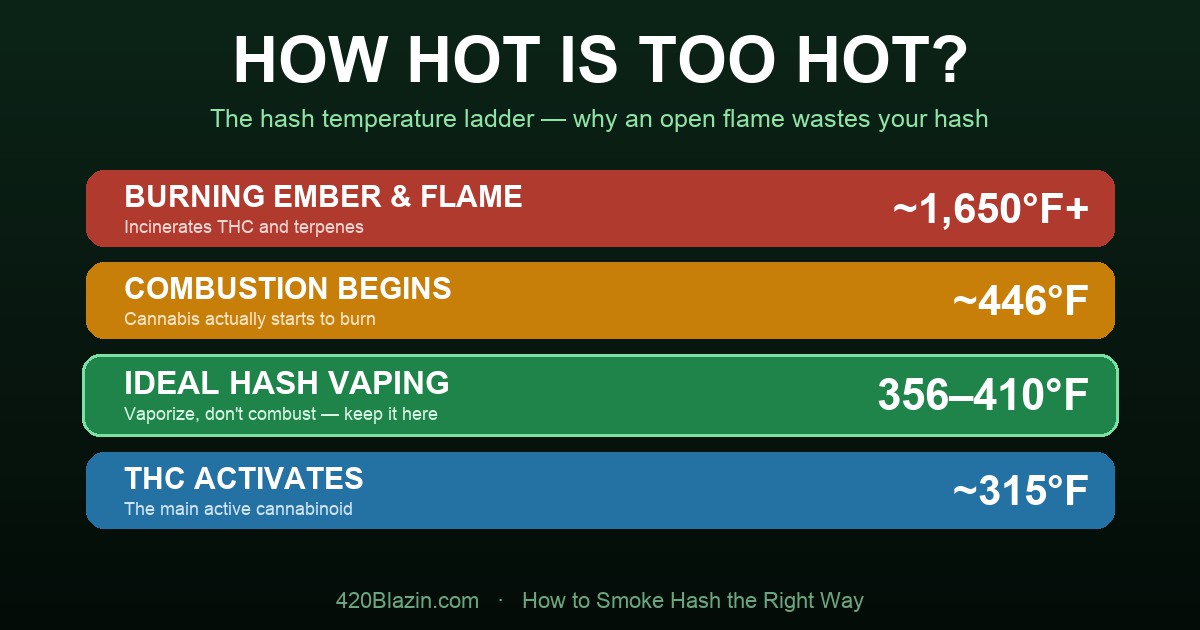
A burning ember — the glowing tip of a joint or cigarette — reaches roughly 900°C (about 1,650°F) at its hottest, and a lighter’s flame is hotter still. (Nature, 1974) But cannabis combusts — actually catches and burns — at around 230°C (446°F). (Alchimia) So when you hold a flame on a raw chunk, you blow past every useful temperature instantly: the outside scorches black, the inside stays unmelted, and most of the THC and the delicate flavor terpenes are simply incinerated before they ever reach your lungs. You’re burning money.
The trick is to heat hash gently and indirectly so it vaporizes instead of combusting. Everything good in hash leaves the material across a window that’s far below a flame:
| Compound / event | Approx. temperature | What it is |
|---|---|---|
| Alpha-pinene | ~156°C / 312°F | Pine terpene |
| THC | ~157°C / 315°F | The main active cannabinoid |
| Beta-caryophyllene | ~160°C / 320°F | Peppery terpene |
| Myrcene | ~166–168°C / 330–334°F | Musky terpene linked to sedation |
| Limonene | ~177°C / 350°F | Citrus terpene |
| CBN | ~185°C / 365°F | Sedating cannabinoid from aged THC |
| Linalool | ~198°C / 388°F | Lavender terpene; calming |
| Ideal hash vaping band | ~180–210°C / 356–410°F | Vaporize, don’t burn |
| Combustion onset | ~230°C / 446°F | Cannabis starts to actually burn |
| Burning ember (joint tip) | ~900°C / 1,650°F | Far past combustion — a flame is hotter still |
Boiling points compiled from Alchimia and VapoChecker. These are reference setpoints, not sharp on/off thresholds.
(One thing you don’t need to worry about when smoking or vaping: decarboxylation. THCA converts to active THC around 220–250°F, and that happens instantly in the heat of any inhalation method. Pre-decarbing only matters for edibles.)
Method 1 (easiest): crumble hash on a bowl of flower
This is the method I’d hand to any beginner or older smoker first. It needs no new gear and it’s very forgiving.
- Pack a pipe or bong bowl about half full with ground flower.
- Warm a rice-grain-sized piece of hash between your fingers until it’s soft enough to crumble, then sprinkle it evenly on top.
- Light the edge of the bowl — not the center — and draw slowly. A hemp wick burns cooler than a butane lighter and is worth the dollar.
Why it works: the flower underneath acts as a buffer, holding the hash above the hottest part of the cherry so it melts and vaporizes into the smoke instead of flaring off. Biggest beginner mistake: using too much hash and torching the center of the bowl. Start with a crumb and let it burn slowly from the edge. (Royal Queen Seeds)
Method 2: a dry-herb vaporizer with a concentrate pad
If you own — or are willing to buy — a dry-herb vaporizer, this is the lowest-harm option on the list, and it’s flameless, which makes it my top pick for older users. A 2026 PAX Laboratories study reported by NORML found that vaporizing cut harmful combustion byproducts (benzene, acetaldehyde, and other pyrolysis toxins) by up to 99% versus joint smoke. That headline 99% comes from an industry-funded study, so take the exact figure with a grain of salt — but the direction is well supported by independent research.
How to do it: most quality dry-herb vapes (the Storz & Bickel Venty and the Mighty+, for example) include a small stainless-steel concentrate pad. Load the hash onto the pad — or sandwich it between two thin layers of ground flower — set the temperature to about 185–210°C (365–410°F), and take slow draws. (RQS notes hash starts to combust around 210–220°C, so that’s your ceiling. (RQS)) On a budget, the XMAX V3 Pro (~$100) punches above its price — see the full dry-herb vaporizer buyer’s guide.
Biggest mistake: letting a bare blob of hash melt straight onto the chamber screen, where it clogs and gums up the device. Load it on the concentrate pad, or sandwich it between two thin layers of ground flower.
The gear that makes hash easy (affiliate links)
- DynaVap “The B” (~$50) — a battery-free manual vape you can load hash straight into. Heat the tip with a torch (or an induction heater), wait for the click, and take a slow sip. The cheapest piece of dedicated, hash-friendly hardware worth owning.
- DynaVap DynaCoil — a little coil insert that drops into a DynaVap tip so it handles sticky hash and waxes without scorching or clogging.
- POTV Lobo concentrate pads — if you run a POTV Lobo, these stainless pads let it vape hash cleanly without gunking the herb chamber.
Method 3: the hash-hole / donut joint
A “hash hole” is a flower joint with a thin snake of hash running down the center, so it melts outward as you smoke and leaves a donut-shaped hole in the ash. It’s a treat — but it takes some rolling skill, which is why it’s a notch harder than the first two.
- Grind ~1.5g of flower and lay down about three-quarters of it on your paper.
- Shape ~0.3–0.5g of hash into a thin snake down the center. (If it’s sticky rosin, chill it 10–15 minutes first so it’s moldable.)
- Cover with the rest of the flower and roll firmly but not tight — air still has to flow. Let it rest a minute or two, then light evenly and rotate as you take slow puffs. (Sensi Seeds)
Biggest mistake: rolling too tight (the hash won’t melt and the joint won’t draw) or torching it. Light evenly and let the hash melt outward. The rolling dexterity makes this harder for arthritic hands than a sprinkled bowl — no shame in sticking with Method 1.
Method 4: a screen in a pipe
You can smoke crumbled or bubble hash on its own in a pipe if you use a metal screen (brass, stainless, or titanium) to hold it in place and stop embers from reaching your mouth. The one catch specific to hash: its oil clogs fine screens fast, so choose a coarser mesh and clean or replace it regularly. (source)
Biggest mistake: using a too-fine screen that instantly clogs with resin, or skipping the screen entirely so loose crumbs get pulled through into your mouth.
Methods to skip (for now): hot knives & dabbing
Two methods come up constantly in old-school hash lore. Neither is where a beginner — and definitely not a senior — should start.
Hot knives / “spotting.” The traditional move: heat two metal blades red-hot, press a dab of hash between them, and inhale the vapor. It’s crude, hard to dose, and burn-prone. Royal Queen Seeds explicitly warns to never inhale through plastic straws or cut plastic bottles — the fumes are toxic and the plastic can catch fire. If you ever do this, capture the vapor only through glass or metal. (RQS) For our money, skip it.
Dabbing. Dabbing full-melt hash on a rig is the most potent route and the steepest learning curve — a torch, a rig, careful timing, and a big single dose. Low-temp dabbing (roughly 400–500°F preserves terpenes for solventless hash; exact numbers vary by source) is the goal, but it’s a lot to manage on night one. And remember: only full-melt (6-star) hash should be dabbed at all — lower grades char and gunk the nail. (Leafly) Come back to dabbing once the bowl-and-vape methods feel routine.
Start low, go slow: dosing for older adults
If you take one habit from this post, take this one: start small and wait. Many guides put a new user’s edible dose at about 2.5 mg of THC — half the standard 5 mg serving — and with hash that means a crumb, rice-grain or smaller, and then wait before more. (Desert Health News)
The reason isn’t caution for its own sake. Older bodies tend to be more sensitive — a little goes a long way — and there’s elevated fall and balance risk, plus the real possibility of interactions with prescription medications. That’s why “start low, go slow” stops being a slogan and becomes a safety rule. This is general education — talk to your doctor about your specific medications before adding cannabis. (More on senior-specific dosing in WEED: A Senior’s Guide to Cannabis.)
Why a “daytime sativa” hash can make you sleepy
Back to my Strawberry Cough puzzle. Strawberry Cough is widely thought to be a cross of Strawberry Fields × Haze, though Leafly itself calls its genetic origins mysterious. It’s classified as an uplifting daytime sativa, and Leafly’s user-reported effects are “uplifted, energetic, happy.” So why did a hash made from it calm me down and put me to sleep?
Four reasons, none of which actually contradict the sativa reputation:
- Hash concentrates everything — including the sedating terpene. Here’s the surprise: Leafly’s aggregate data lists Strawberry Cough as myrcene-led (then pinene, then caryophyllene), not terpinolene-dominant like most energetic sativas. Myrcene is the terpene most associated with sedation and “couch lock.” Concentrate the flower into hash and you concentrate that myrcene right along with the THC.
- The indica/sativa label doesn’t predict effect. A 2022 PLOS ONE analysis of more than 90,000 samples found product labels poorly reflect the actual chemistry — sativas don’t reliably differ from indicas. (National Geographic) Chemovar (the terpene + cannabinoid profile) and dose drive the experience, not the word on the jar.
- Cannabinoids are biphasic. Lower doses tend to calm; higher doses can flip to anxious and edgy for some people (Aparisi Rey et al., 2012, in a CB1-agonist animal model). And a bigger total dose of THC is simply more likely to leave you heavy and sedated. Because hash is far stronger than flower, a puff that feels normal delivers a large dose — which can nudge the effect toward sleep.
- Pressed and aged hash carries more CBN. CBN is the sedating compound that THC degrades into over time, and it accumulates in oxidized, pressed material. A 2024 rat study gave the first objective evidence that CBN influences sleep — increasing total sleep time, though with an initial wakeful phase first — but it’s animal data, so this is suggestive, not proven. (Arnold et al., 2024)
Put together: “sativa” was never a guarantee I’d feel energized, especially in a concentrated, higher-dose hash form whose dominant terpene leans sedating. The label lied; my body didn’t. (This is the same lesson behind The Nose Knows — read the terpenes, not the category.)
Hash and sleep: what the science does & doesn’t say
Because this is where my story started, let me be careful and honest about it. The research on cannabis and sleep is genuinely mixed:
- Cannabis and THC may shorten the time it takes to fall asleep, but the evidence on staying asleep is mixed. (Babson et al., 2017)
- Tolerance to the sleep benefit builds with regular use, and stopping abruptly can trigger vivid dreams or rebound insomnia.
- Myrcene’s sedation reputation is folk knowledge — Leafly notes there are no well-controlled human trials proving it. (Leafly) The CBN sleep evidence is preliminary and mostly animal data.
So I’ll tell you what worked for me — it calmed me and helped me sleep through the night — without telling you it’s a treatment. It isn’t a treatment, and nothing here is medical advice. If you’re chasing sleep, the responsible move is a small dose, a conversation with your doctor about your other medications, and honest attention to whether it’s still working in a month.
Where to buy hash in the Midwest (Ohio & Michigan)
Good news for legal-market shoppers: hash and especially hash rosin are widely sold now.
Ohio. Adult-use cannabis is legal for 21+ — Issue 2 passed in November 2023, with a possession cap of 2.5 oz of flower / 15 g of concentrate. (MPP) Solventless is well represented — Klutch is a standout Ohio producer; a 2026 price drop put its live hash rosin at $50 (full spectrum) and $60 (micron-specific) per gram. You’ll find solventless on Cleveland-area menus — see our Cleveland dispensary rundown.
Michigan. Where my Strawberry Cough hash came from. Dacut is a Michigan dispensary chain — Detroit, Monroe, and Flint, with New Buffalo coming soon — and its menu includes a concentrates category. Michigan’s oversupplied market often runs cheaper than Ohio. Whatever state you’re in, check the COA on the package for the exact THC percentage before you decide how big your “rice grain” should be.
Frequently asked questions
How do I smoke hash if I’m a complete beginner?
The easiest, safest way is to pack a pipe or bong bowl about half full with ground flower, crumble a rice-grain-sized piece of hash on top, and light the edge of the bowl — not the center. The flower buffers the embers and slows the burn. Start with a tiny amount because hash is roughly 2–4× stronger than flower.
Can I just light a chunk of hash with a lighter?
No. A burning ember reaches around 900°C and a lighter’s flame is hotter still, while cannabis combusts near 230°C (446°F). Holding a flame on a raw lump scorches the outside black, leaves the inside unmelted, and burns off the THC and the flavor terpenes. Always warm and crumble hash first, then sprinkle it on flower or use a vaporizer with a concentrate pad.
How much hash should an older beginner take?
Start very low — think a crumb the size of a grain of rice — and wait before taking more. Older bodies tend to be more sensitive to cannabis, so a little goes a long way, and there are added fall and medication-interaction risks. A common starting point for new users is about 2.5 mg of THC. This is general education, not medical advice; talk to your doctor about interactions.
What’s the difference between hash, bubble hash, and hash rosin?
Kief or pressed hash is sifted trichome powder, sometimes pressed into a block. Bubble (ice-water) hash is solventless, made by washing frozen flower in ice water and filtering through micron mesh. Hash rosin is bubble hash pressed with heat and pressure into an oil, often 60–90% THC. Rosin is solventless and the most flavorful. Distillate, by contrast, is lab-refined to about 99% THC with the terpenes stripped out.
What does “full melt” mean, and can I dab my hash?
Hash is graded 1–6 stars by how cleanly it melts. Full melt (6-star) liquefies completely with no residue and can be dabbed or vaped; 5-star almost fully melts with only minimal residue. Lower grades leave more residue and should be sprinkled in a bowl or joint instead. If your budtender didn’t say “full melt” or “6-star,” assume it’s sprinkle-grade and don’t dab it.
Why does my Strawberry Cough hash make me sleepy if it’s a sativa?
Because the “sativa” label doesn’t reliably predict effect — chemistry and dose do. Hash concentrates the sedation-associated terpene myrcene (Strawberry Cough’s dominant terpene per Leafly) and raises the total THC dose, and high THC doses can tip toward sedation. Pressed and aged hash also carries more CBN, a sleep-associated cannabinoid. The evidence on terpenes and CBN is still preliminary, so this is educational, not a treatment claim.
Is vaporizing hash safer than smoking it?
Vaporizing avoids combustion, so it produces far fewer harmful byproducts. A 2026 PAX Laboratories study (reported by NORML) found vaporizing cut combustion toxins like benzene and acetaldehyde by up to 99% versus a joint. Attribute the exact figure to PAX (an industry source), but the direction is supported by independent research. For hash, load it on a vaporizer’s concentrate pad or sandwich it in ground flower — don’t let a bare blob melt onto the chamber screen.
Want the whole picture for older beginners? WEED: A Senior’s Guide to Cannabis by Blazin Bill covers dosing, terpenes, consumption methods, and drug-interaction charts — the reference I wish I’d had standing in my kitchen that first night.
Continue reading
Affiliate Disclosure: Some links on this page are affiliate links to Planet of the Vapes and Amazon. We may earn a commission at no extra cost to you.
Disclaimer: This article is for educational purposes only and does not constitute medical advice. Cannabis affects everyone differently, and the research on terpenes, CBN, and sleep is still preliminary. Consult a healthcare professional before using cannabis, especially alongside prescription medications. Ohio and Michigan require 21+ for adult-use purchase. Cannabis remains federally classified as Schedule I.